Submitted by Dr A Röschl on Fri, 01/03/2025 - 02:39
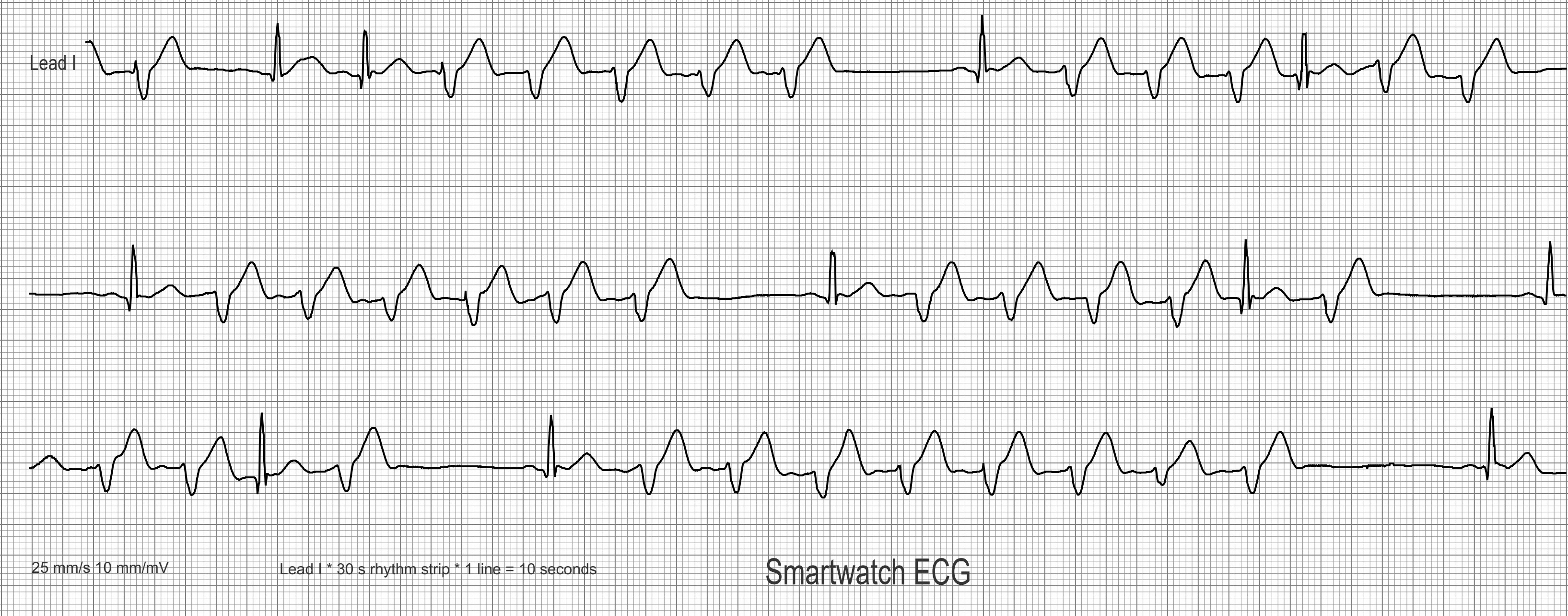
Here we see a 30 s long strip of a 1-lead ECG rhythm strip, recorded with a modern Smartwatch (Apple watch). The ECG has been graphically processed for better visualization. The paper speed is 25 mm/s as usual. The lead shown corresponds to ECG lead I of the limb leads.
Submitted by Dr A Röschl on Sun, 11/19/2023 - 04:52
Many people are considerably unsettled by ECG recordings from smart watches. However, smartwatch ECGs can be helpful in the diagnosis of paroxysmal atrial fibrillation. Here. you can see an example. It is a 1-channel ECG that corresponds to lead I. Initially there is an irregular fast pulse without P waves, which corresponds to a tachyarrhythmia in atrial fibrillation. At the end of the first line, after a very short pause, there is sinus rhythm. In the third line you see a short SVT over 3 beats, then SR again. The QRS complex is widened to over 120 ms.
This is a good basic rhythm strip example of atrial fibrillation with a rapid ventricular response showing the identifying characteristics of atrial fibrillation: no P waves, an irregularly-irregular rhythm, and a "fibrillatory" baseline. The wavy baseline will not be seen in all leads in all patients, so it is best to use the first two findings as diagnostic criteria. Atrial fib often appears initially as a rapid rhythm, as the AV node is being bombarded by many impulses from multiple foci (pacemakers) in the atria. Depending upon the AV node's ability to transmit these impulses,however, we could see a slow, normal, or rapid ventricular response.
Atrial fib has very chaotic depolarization of the atrial muscle, resulting in quivering and ineffective pumping of the atria. This loss of "atrial kick" can severely reduce ventricular filling, and can reduce cardiac output by as much as 25%. In patients with a very rapid rate, cardiac output can be further reduced, causing CHF. In addition, the fibrillating atria can form blood clots due to sluggish movement of blood. These clots can embolize and cause stroke. For these reasons, patients with atrial fib are anticoagulated and sometimes the atrial fib is stopped by medical, surgical, or electrical therapy. Recurrence of atrial fib is common after treatment, and for some patients, control of the ventricular rate and anticoagulation become the preferred treatment.
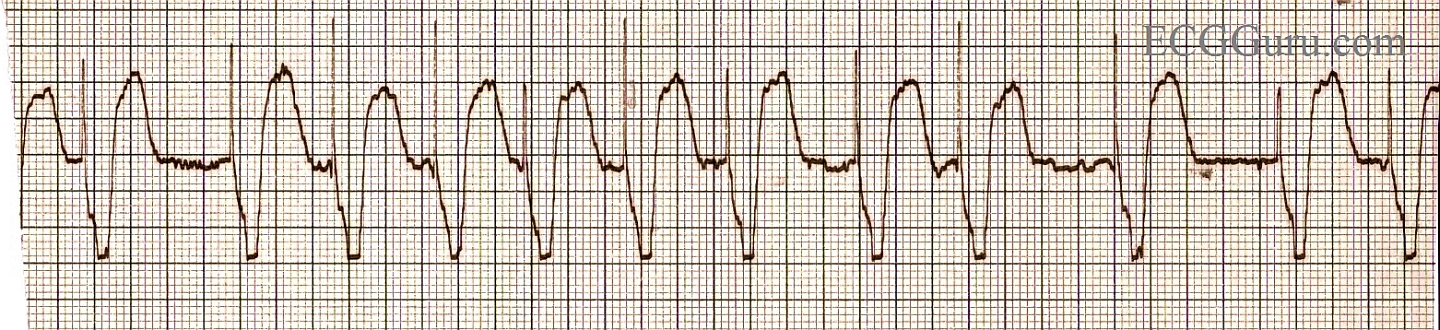
PACEMAKER MEDIATED TACHYCARDIA is a term for several different mechanisms that cause inappropriately fast rates in a paced patient. It is a very interesting topic, which I will not attempt to discuss here, because it has been done to perfection by DR. KEN GRAUER, MD, with assistance from JASON ROEDIGER, CCT, CRAT in Dr. Grauer's ECG Consult #13 Please follow this link to a concise, complete, and illustrated discussion of PMT.