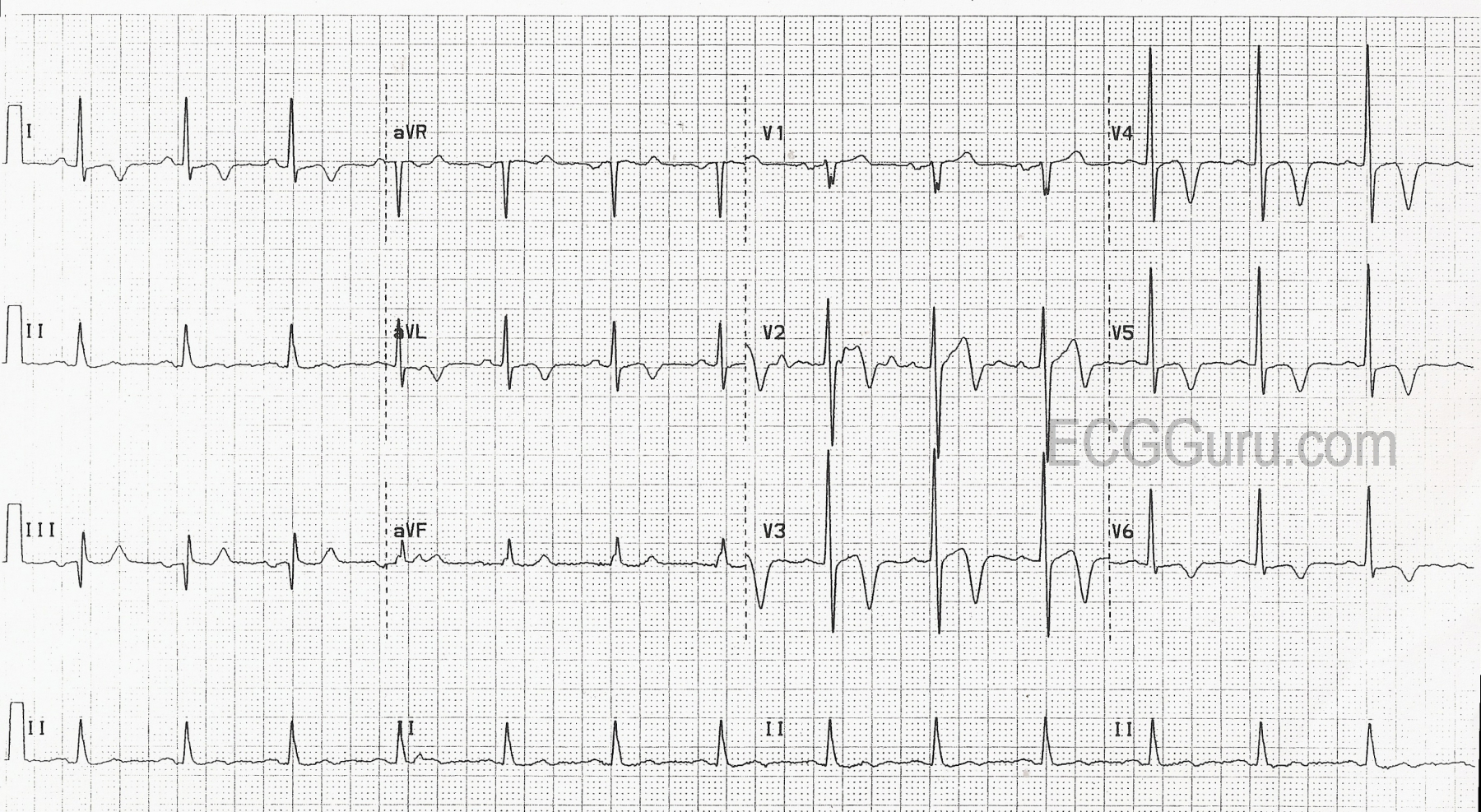
Hein J. J. Wellens and colleagues described in 1982 an ECG pattern present in people who had experienced an episode of angina and who were currently pain-free. This pattern was shown to be a reliable indicator of severe stenosis of the left anterior descending artery. It has also been called "Wellens' Warning" because it is a significant finding in patients who are pain-free, as it has been associated with 50% or more occlusion of the LAD and subsequent anterior wall M.I. The pattern can come and go, alternating with a typical pattern of ST elevation during periods of chest pain. It indicates reperfusion of the LAD, but it must be stressed that spontaneous reperfusion is often a fleeting situation.
The ECG criteria are applied to a patient who has had previous and recent chest pain, but who is currently pain-free. Cardiac blood markers may be normal or only slightly elevated:
* Deep, symmetrical T wave inversion in V2 and V3. Often biphasic, but may evolve to be completely negative. May extend to other precordial leads.
* NO or very little ST elevation at the J point.
* No precordial Q waves
* Preserved R wave progression in precordial leads.
Sometimes seen in cases of Takotsubo cardiomyopathy.